
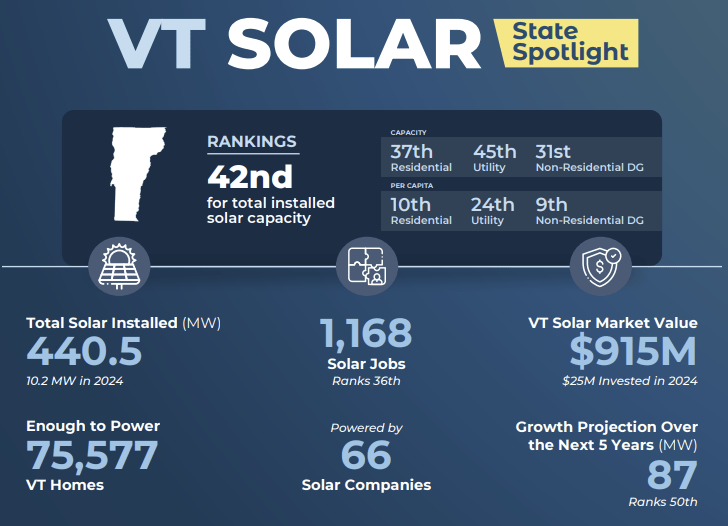
Vermont ranks 42nd for total installed solar capacity in the US. Before 2020, Vermont was adding substantial utility-scale and commercial solar capacity, but since the pandemic, that capacity has dropped off.
The state is not home to many solar incentives, but with an average electric rate in 2024 of $0.1747/kWh, which has increased more than 20% over the last 10 years, homeowners and businesses in Vermont can benefit from significant energy savings by switching to solar. A major utility in the state, Green Mountain Power, also has a VPP (Virtual Power Plant) program helping with energy resiliency.
Below is a breakdown and links to incentives available to homes and businesses making the switch to solar. You can find a full list and more details at https://programs.dsireusa.org/system/program/vt
Table of Contents
Federal Incentives
Federal Investment Tax Credit (ITC)
Residential solar and energy storage systems installed in Vermont in 2025 are eligible for the Federal ITC, which provides up to 30% credit toward the total cost of a solar system.
The credit is non-refundable, meaning it cannot exceed the amount you owe in tax and would not directly increase any refund you would receive. Excess credit can be carried forward and used in future years.
Previous legislation had this credit available until 2032, but due to the passing of H.R. 1, “the big beautiful bill”, homeowners are only able to claim this credit if their system is installed before December 31st, 2025. Systems installed starting in 2026 will not be able to receive any federal solar tax credits. Learn more about the changes to the tax credit here.
Commercial systems or systems owned by a third party (lease or PPA) can still benefit from the federal tax credit until December 31st or 2027.
Modified Accelerated Cost Recovery System (MACRS)
IRS Section 179 depreciation allows certain qualified properties to be classified as 5-year properties, and tax credits are taken on the depreciation. This credit applies to commercial sites and certain investment properties.
Due to the passing of H.R. 1, the one big beautiful bill, this credit will expire at the end of 2027. Specific information on what qualifies can be found on the IRS website.
State Incentives & Programs
Local Property Tax Exemption
Vermont allows individual municipalities to vote on whether solar installations are exempt from property tax valuation. If the municipality chooses to exempt, homeowners would not see increased property taxes due to the solar installation, which increases property values anywhere from 5-10%.
According to Zillow, the average home price in Vermont is $400,247. Installing solar could increase the home’s value anywhere from $20,012 – $40,024, and if exempt, homeowners wouldn’t have to pay any extra property taxes.
Uniform Capacity Tax Exemption
Vermont has a Uniform Capacity Tax that requires solar and grid-connected storage projects to pay taxes based on the capacity of the system. Solar installations greater than 50 kW in size are required to pay $4 / kW annually, and storage projects over 600 kWh in capacity are required to pay $0.50 / kWh annually.
Systems under those thresholds, which include most residential systems, are exempt from UCTs.
Business Investment Tax Credit
Vermont offers tax credits to businesses that make investments in energy production. The credit is equal to 24% of the federal investment tax credit claimed, equivalent to a 7.2% state tax credit. The federal tax credit will not be available after 2027; no word on whether this program will go away as well.
Sales Tax Exemption
Originally enacted in 1999, Vermont exempts solar equipment from the states 6% sales tax. The exemption applies to systems up to 500 kW in capacity and includes some other renewable energy projects.
Vermont Economic Development Authority (VEDA) Commercial Loan Program
The Vermont Economic Development Authority (VEDA) offers a loan program to commercial systems. The program is intended to help businesses finance qualifying renewable energy generation and energy efficiency improvement projects.
The maximum loan size is $6 million with a variable rate and $500,000 with a fixed rate, and is generally limited to 60% of the project cost, but in some cases can cover up to 90%. Funds from this loan must be used for the purchase of land or buildings, construction, installation, design, engineering, and permitting.
Vermont Economic Development Authority (VEDA) Agricultural Loan Program
VEDA, in cooperation with the Vermont Agricultural Credit Corporation, offers a loan program to farmers looking to invest in renewable energy generation. The program has a maximum loan of up to $5 million.
Green Mountain Power Battery Storage Program
Green Mountain Power, a large energy utility in Vermont, offers a virtual power plant program for homeowners installing battery storage. Homeowners can choose between two different options:
- Energy Storage Lease – have two Tesla Powerwall 2 batteries installed on their home for $55/month or a one-time payment of $5,500. For a 10-year lease term, homeowners can benefit from emergency backup power, but GMP is also able to discharge the batteries to stabilize the grid when needed.
- Bring Your Own Device Program – homeowners installing solar and storage could enroll their qualified device to be discharged 5-8 times per month. In exchange, homeowners can receive between $850-$950 per kW discharge capacity.
Net Metering
Solar panel systems connected to the grid in Vermont can benefit from Net Metering, a program where solar systems send excess power back to the grid. Generally available for projects up to 500 kW in size, customers are credited for their Net Excess Generation at a blended rate that includes rates from multiple electric utilities.
As of 2024, the statewide blended residential rate was set at $0.18398/kWh.
The Future of Solar in Vermont
Without the introduction of new state-level incentives, Vermont’s solar market will likely stay roughly where it is in terms of total capacity. However, expect battery storage to surge with programs like Green Mountain Power’s storage lease leading the way. Overall, homeowners in Vermont can benefit greatly from switching to solar, even in their wintery conditions.
Homeowners going solar in Vermont should make sure to do their research when going solar and check out all their options. If you’re looking for a high-quality install where your equipment is protected for 30 years, and you’re protected from surprise labor costs, look for a Solar Insure Certified Provider and an SI-30 warranty.

Solar Costs and Financing: A Complete Guide
Learn more about solar costs, the various options to pay for it, what incentives are available, and how to run the numbers for your specific...Continue reading→

Going Solar: The Complete Guide for Homeowners
Is Going Solar Right For Your Home? Going solar is one of the most impactful home upgrades you can make, but it’s not the right...Continue reading→

Solar Direct Shutdown Leaves Homeowners Stranded
Solar Direct, a Sarasota-based solar company, has abruptly shut down, leaving many homeowners with unfinished installations, broken systems, and no clear path forward. According to...Continue reading→
