
Key Takeaways
Tesla power zones are a new panel design approach that divides solar panels into multiple electrical sections (up to 18 zones) to reduce energy losses from partial shading, a common issue that can cause 8–13% production losses in residential systems. By isolating shaded areas within the panel itself, power zones aim to maintain higher output compared to traditional panels, though similar shading mitigation already exists through technologies like microinverters, optimizers, and half-cut cells. While this innovation may improve performance on complex or partially shaded rooftops, overall system design, including panel placement and inverter selection, remains the most critical factor in maximizing solar production.
Solar Providers – ready to offer unmatched value for your clients? Apply to become a Solar Insure Certified Provider.
Homeowners/Business Owners – Learn more about our warranty offerings here.
Shading has been one of the most persistent performance challenges in residential solar. Trees growing, the sun behind nearby structures, and even debris can cast shadows across panels. These small interruptions may seem minor, but they can create efficiency losses that are often difficult to mitigate once a system is installed.
The conditions on rooftops are rarely perfect, and over the years, manufacturers have developed technologies to reduce the impact of partial shading. Recently, Tesla introduced its new solar panels, in which it increased the number of “power zones.” These power zones are said to maintain stronger energy production even when portions of the panel are shaded.
While Tesla presents power zones as a new approach to shading mitigation, the broader question is how this design compares with existing technologies for addressing shading in residential rooftop systems.
Table of Contents
The Impact of Shading and Solar Panel Performance
Shading can be more than just a minor inconvenience in solar energy systems. In some cases, it can determine whether a rooftop is suitable for solar at all. Even small obstructions like tree branches, roof vents, chimneys, shifting sun angles, or debris can interrupt sunlight reaching panels and reduce overall energy production
Research from the National Laboratory of the Rockies (NLR) shows that partial shading can cause disproportionately large losses, depending on the size and shape of the shadow and how it falls on the panel.
One challenge in recognizing shading-related issues is that solar production naturally fluctuates day to day. Weather patterns, cloud cover, seasonal changes in sunlight, and temperature all influence system output. Since these normal variations, short-term dips in production are common and usually not cause for concern. However, consistent declines in output over several weeks, especially during high-production seasons, can indicate that something is interfering with system performance, and shading is often the cause.
Why Shading Has A Large Impact
From an engineering perspective, shading affects solar panels because most panels are built with cells that are connected in series. With a series of connected cells, electricity must pass through each cell sequentially. If one portion of the panels receives less sunlight, it can limit the electrical current flowing through the circuit, reducing the panel’s output. It’s not just the panels that are affected by shading; the extent of the impact will also depend on the inverter used to convert the panel’s electricity.
String Inverters
With string inverters, multiple panels are wired together in a series “string”. Since they share the same electrical pathway, the performance of the entire string can be limited by the lowest-performing panel. If one panel becomes shaded, the output of the entire string may drop to match that panel’s reduced performance.
Microinverters
Mircoinverters operate differently from string inverters by converting power at the individual panel level. Each panel functions independently with its own inverter. This typically means that shading on one panel affects only that panel. The rest of the system continues producing normally. This architecture helps prevent the cascading production loss.
Power Optimizers
Power optimizers sit between these two approaches. Each panel is equipped with a small device that conditions and optimizes the panel’s DC output before sending electricity to a central inverter. This allows each panel to operate closer to its maximum potential, even if its neighboring panels are shaded, essentially isolating shading issues.
Further research by NLR states that shading-related electrical mismatch can account for median energy losses of roughly 8-13% across residential solar systems. This mismatch occurs when shaded cells generate less current than fully illuminated cells, effectively limiting the electrical flow through the circuit. In string inverter systems, this can reduce the output of multiple panels connected in the same string, while microinverters and power optimizers can help isolate panel performance and reduce the impact of a single shaded panel on the rest of the system.
The consequences of shading can extend beyond lower electricity generation. Under certain conditions, shaded cells may begin to dissipate energy as heat rather than electricity, creating hot spots. Those hot spots can accelerate module degradation.
To limit these risks, solar panels have long included bypass diodes. These components allow electricity to bypass shaded sections of panels, so the entire module does not shut down when partially shaded. However, most panels divide the module into only two or three sections, which means shading can still affect production.
As a result, manufacturers and researchers have explored ways to increase the number of electrical segments within a panel, allowing smaller portions of the module to operate independently. Studies show that dividing panels into more operating zones can improve performance under partial shading by allowing unaffected sections of the panel to continue generating electricity.
This underlying engineering challenge, how to maintain energy production when only part of a panel receives sunlight, is the problem Tesla’s “power zones” are attempting to address.
What are Tesla Power Zones?
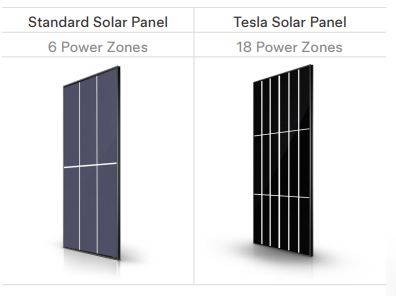
Tesla power zones divide a solar panel into multiple smaller electrical sections, 18 zones in Tesla’s TSP panels, so that when shading occurs, only the affected zone loses production while the rest of the panel continues generating electricity.
The concept is similar in principle to how the industry has already improved shading tolerance through technologies like half-cut cells, multi-busbar designs, and panel-level electronics.
Today, half-cut cell designs are used in most modern solar panels because they improve efficiency and reduce the impact of partial shading. The difference is that Tesla is attempting to integrate this segmentation directly into the panel architecture itself.
As mentioned, traditional solar panels have bypass diodes that protect sections of the panel. Tesla’s approach attempts to push that concept further. Instead of a few protected sections, Tesla’s TSP panels are divided into 18 smaller electrical zones. When shading occurs, only the specific zone affected loses production while the rest of the panel continues generating electricity. This segmentation is designed to mitigate partial shading caused by common rooftop obstacles, such as chimneys, vents, dormers, or nearby trees.
Rather than relying primarily on system-level electronics to isolate shading impacts, Tesla is attempting to integrate shading mitigation directly into the panel architecture itself. The idea aligns with the broader direction the industry has been moving toward: breaking solar production into smaller operating units so that shading affects less of the system.
Comparison of Shading Mitigation Technologies
| Technology & Example Manufacturer/Product | How It Reduces Shading Impact | Key Consideration |
| Tesla Power Zones (TSP Series Module) | Panels are divided into ~18 electrical zones so shading affects only a small portion of the module | Newer architecture with limited long-term field data |
| Half-Cut Cells (Qcells Q.TRON / Q.PEAK DUO, REC Alpha Pure) | Cells are split into smaller circuits, so shading impacts a smaller section of the panel | Still limited by diode group segmentation |
| Multi-Busbar (MBB) (REC Alpha Pure, Panasonic EverVolt) | Multiple current pathways across cells help electricity flow even if small areas are shaded | Improves efficiency but does not isolate large shaded areas |
| Panel-Level Electronics (Enphase IQ8 Microinverters, SolarEdge Optimizers, Tigo TS4) | Each panel operates or is optimized independently, so shading on one panel doesn’t affect others | Adds additional electronics and system complexity |
Where Power Zones May Matter Most
The potential benefit of technologies like power zones becomes more apparent when looking at the types of rooftops where partial shading is unavoidable. While some homes have large, unobstructed roof planes, many residential rooftops include architectural features or nearby obstructions that create shifting shade patterns throughout the day.
Common sources of rooftop shading include chimneys, roof vents, dormers, nearby trees, and neighboring buildings. These elements can cast moving shadows across solar panels as the sun changes position, creating uneven sunlight across an array. Studies on rooftop photovoltaic systems have shown that shading from surrounding structures and vegetation is a primary constraint in assessing whether a roof is suitable for solar.
Complex roof designs can also increase the likelihood of partial shading. Architectural elements such as dormers or multiple roof planes can interrupt sunlight across portions of an array at different times of day. Research examining photovoltaic installations in urban environments notes that obstructions such as trees, poles, exhaust pipes, and dormers often create localized shading on rooftop solar systems.
Arrays installed on east–west roof orientations may also experience uneven sunlight across panels as the sun moves from morning to afternoon positions. In these situations, portions of the array may receive direct sunlight while others operate under partial shading conditions for part of the day.
In these environments, technologies that localize the impact of shading can help limit how much of the system loses production. Whether the solution comes from panel-level electronics or from segmentation within the panel itself, the goal is the same: reduce the portion of the system affected when sunlight across the array is uneven.
By dividing panels into smaller electrical zones, designs like Tesla’s power zones aim to minimize the panel surface area that stops producing power when partial shading occurs—an approach that may be particularly useful on rooftops, where shading cannot be completely avoided.
System Design Still Matters
While innovations like power zones can improve how panels respond to uneven sunlight, no panel technology can eliminate shading losses. In practice, system design still plays the largest role in solar performance. Proper panel placement, inverter selection, and the management of nearby tree growth often have a greater impact on production than the specific panel architecture. Even the most advanced module designs cannot overcome poor system layout or heavy, persistent shading.
Technology can help manage shading, but thoughtful system design remains the most reliable way to maximize solar production.
Final Takeaway
Tesla’s power zones are the latest attempt to address one of the most persistent challenges in residential solar. By dividing panels into more electrical zones, the design aims to limit the amount of the panel that loses production when part of it is shaded.
At the same time, the idea behind power zones is not entirely new. Over the years, the industry has introduced multiple ways to manage shading, from panel design improvements to system-level solutions. What makes Tesla’s approach different is where the shading mitigation happens. Instead of relying primarily on system electronics or a small number of diode-protected sections, Tesla is attempting to handle shading directly within the panel by increasing the number of operating zones.
Whether this becomes a meaningful step forward will ultimately depend on how the technology performs in real-world rooftop conditions. In practice, most residential systems today rely on a combination of panel design, inverter architecture, and system layout to manage shading.
What Tesla’s power zones really highlight is the industry’s continued push to make solar systems more resilient to the realities of residential rooftops, where perfect sunlight conditions are rarely guaranteed.
Frequently Asked Questions About Tesla Power Zones
Do Tesla power zones eliminate shading losses?
No. Power zones reduce the extent to which a panel is affected by shading, but they cannot eliminate production losses entirely when large areas of a panel are shaded.
How are power zones different from microinverters?
Power zones segment shading impact within the panel, while microinverters isolate shading impact between panels.
Do power zones replace power optimizers or microinverters?
No. Power zones address shading at the panel architecture level, while microinverters and power optimizers operate at the system electronics level.
Will power zones increase solar production?
In environments with partial shading, such as rooftops with chimneys, vents, or nearby trees, power zones may help maintain higher production compared with panels that have fewer electrical segments.
Follow Solar Insure on our social media channels to stay connected with the latest industry insights, trends, and expert perspectives. Discover valuable updates, helpful tips, and keep yourself informed and empowered in the evolving solar landscape.
Is your solar company out of business? SolarDetect offers expert remote Solar Health Checks and can connect you with a vetted, quality service provider when needed. Visit https://detect.solarinsure.com/
