
Key Takeaways
The SolarEdge Nexis Solution is a next-generation all-in-one inverter and battery system designed to simplify installations, reduce failure points, and improve system scalability. Its stackable design, “Simple Click” connections, and single-SKU inverter streamline installation while delivering high performance, including up to 74.4 kWh per inverter and 223 kWh total capacity. With improved power output, stronger LRA for heavy loads, and flexible expandability, Nexis positions SolarEdge as a competitive player in the growing home battery market, especially for homeowners looking to scale over time.
Solar Providers – ready to offer unmatched value for your clients? Click here to apply to become a Solar Insure Certified Provider.
Homeowners/Business Owners – Learn more about our warranty offerings here.
SolarEdge first announced its next-generation inverter/battery all-in-one unit, the SolarEdge Nexis Solution, at RE+ 2025 in Las Vegas, Nevada. As the 2026 launch gets closer, I had the chance to see the unit in person and sit in on sessions breaking down how it actually works at the NABCEP’s Continuing Education Conference in Milwaukee, Wisconsin.
What I saw was a thoughtfully designed unit that could meet many of the growing market’s needs. Instead of piecing together separate components, SolarEdge is aiming to reduce installation complexity, minimize points of failure, and create a more predictable system for both installers and homeowners.
The intention is there, but what matters most is how it performs once installed, how it holds up over time, and whether it can stack up against the other battery options on the market.
Table of Contents
A Newcomer to The Stackable Market

There are several big changes SolarEdge made when they redesigned the Nexus unit. The stacked installation of the unit is the most obvious, but there are also major changes to the maximum power output and expandability.
One of the hallmarks of SolarEdge’s new design is that all components are neatly stacked to reduce space and significantly speed up installation. Each Nexis unit contains three key components: an inverter, a battery link, and at least one battery. SolarEdge claims this architecture uses between 20% and 40% less wall space than leading string and microinverter setups.
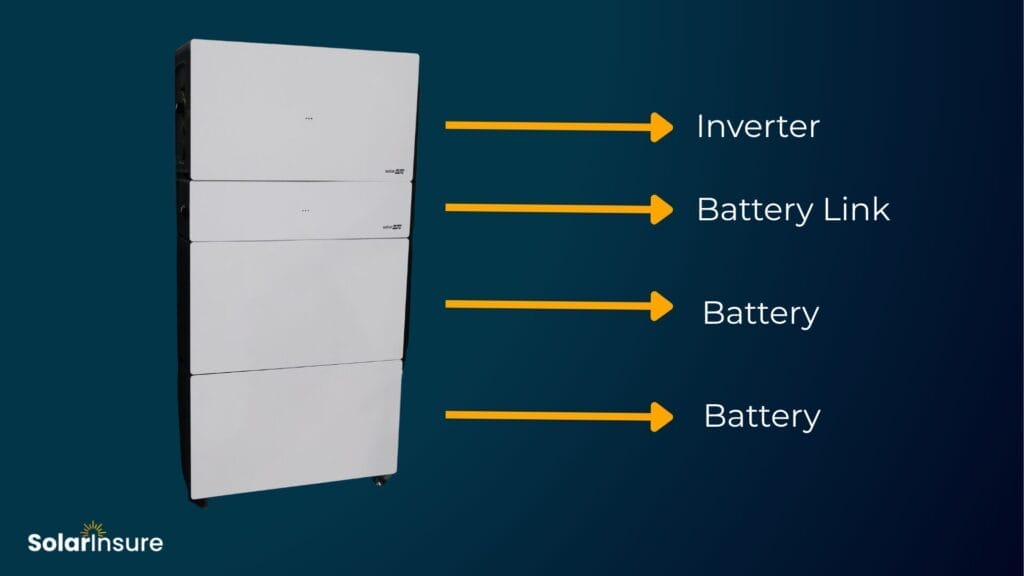
SolarEdge has designed a special connection port on these components that allows them to simply click together when stacked. This connection, which they call “Simple Click”, contains all the direct current (DC) and communications connections, so no additional internal wiring work is needed.
Rather than spending time running lines between units for all connections, simply stack the units, leaving only the alternating current (AC) connection to be wired. That’s a major win for install time.
The Inverter
Both the Nexis and its predecessor, the Home Hub, feature 99% efficiency, a standard for SolarEdge systems. Additionally, the unit ships as a single-SKU unit, meaning there’s only one part number rated at the highest, 13 kW.
When installing systems that require a smaller inverter, installers can derate the inverter to the required size, reducing stock headaches and tracking different-sized inverters.
The Home Hub inverter maxed out at 11.4 kW, but the new Nexis systems are capable of 13 kW on grid and 14.5 kW off-grid. With SolarEdge allowing 200% oversizing, 23 kW of solar could be connected to a single inverter, which could output up to 60A in backup operation.
The Battery
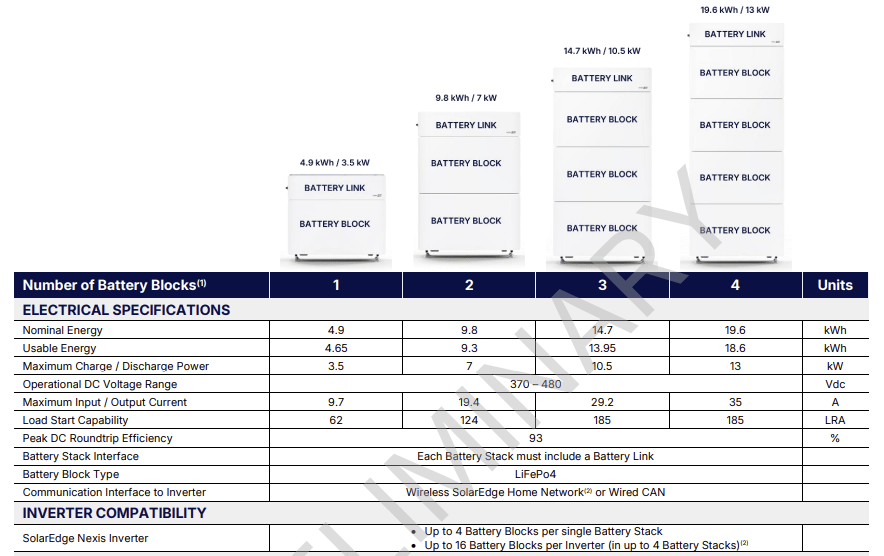
SolarEdge has changed the chemistry of the battery itself to LFP (Lithium Iron Phosphate) to match what is becoming more common in the market. The batteries are indoor and outdoor rated, with a temperature range of -4° F to +131°F, and SolarEdge increased the maximum altitude to 9,842 feet.
Just like the older battery, these are DC-coupled for maximum efficiency. However, they can also be AC-coupled to existing systems. SolarEdge is definitely pursuing maximum expandability with these units.
Expandability
Each battery block has a nominal capacity of 4.9 kWh, but a total usable capacity of 4.65 kWh. The older units had a usable capacity of 9.8 kWh. While at first glance this looks like a downgrade, Nexis actually greatly improves on the total energy capacity.
Each battery stack can support 4 battery blocks, and each inverter can support 4 battery stacks, for a total of 16 batteries per inverter, or 74.4 kWh usable capacity. Comparatively, the previous generation of batteries could only support three batteries per inverter, for a maximum of 29.4 kWh usable capacity.
The previous system could support 3 inverters per backup interface, so 9 batteries for a theoretical max system or 87.3 kWh usable capacity. The Nexis can support almost as much capacity on a single inverter, and three inverters can be connected to a single 200A service, allowing for a massive 223 kWh.
Output Power and LRA (Locked Rotor Amps)
If you’ve read some of my other battery deep dives, you’ll know that one of the key metrics I like to look at is max continuous discharge power – how much power a battery can output at one given time to power simultaneous loads in the house.
For the Nexis system, a single block can output 3.5 kW (about 14 A), and a full system capable of 14.5 kW in backup could output up to 60 A continuous, enough to power even heavy loads like AC units.
SolarEdge made a big improvement to its battery’s LRA, or Lock Rotor Amps. LRA refers to the amperage required by heavy loads, such as motors, to start up. It’s a quick burst of energy to get started, while the running amperage is much lower.
The Nexis with 3 or 4 battery blocks can achieve an LRA of 185A, more than enough for heavy home loads. The previous battery could only achieve 106A with a three-battery setup.
Warranty
The new Nexis solution is backed by a 10-year warranty. The warranty states that the battery will retain at least 70% of its capacity at the end of the warranty period, which aligns with industry standards. The warranty also features unlimited cycles.
SolarEdge Nexis on the Solar Insure AVL
At Solar Insure, we strive to make solar a secure investment for homes and businesses that make the switch to clean energy. Our Approved Vendor List (AVL) manufacturers are rigorously vetted, and only equipment from the AVL can be covered by a Solar Insure warranty.
SolarEdge and its new Nexis solution are included on our AVL, so homeowners looking to install the system can get 30-year material and labor cost protection with an SI-30 Total or SI-30 Battery warranty.
Learn more about our warranties and contact our team about finding a Certified Provider near you: https://www.solarinsure.com/for-homeowners
Nexis Market Impact and How it Compares to the Industry
The Nexis is clearly a major upgrade for SolarEdge storage systems from both a technical perspective and an installation perspective. While the single battery usable capacity is lower than that of the previous generation, the expandability and power output greatly outpace what came before. For installers, the stackable architecture will speed up installs and leave less room for error.
So how does the new Nexis system stack up to the competition in the market? We previously wrote about the Best Batteries for 2026, and comparing Nexis to that list, it falls in line with a lot of the top of the industry.
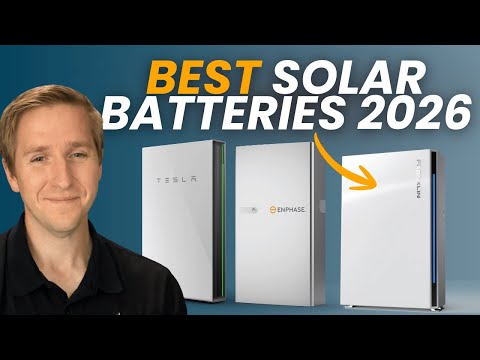
It doesn’t touch the single battery output potential or expandability of units like Fortress Power’s eForce stackable unit or EG4’s Wallmount Battery, but if we compare a Nexis with 3 battery blocks to others on the list, the Nexis falls in line with and in some cases outperforms other names on the list, like Enphase and Tesla.
Overall, I think the Nexis is a great addition to the market, especially for homeowners who may want to start small and expand as time goes on or their energy needs change.
Follow Solar Insure on our social media channels to stay connected with the latest industry insights, trends, and expert perspectives. Discover valuable updates, helpful tips, and keep yourself informed and empowered in the evolving solar landscape.
Is your solar company out of business? SolarDetect offers expert remote Solar Health Checks and can connect you with a vetted, quality service provider when needed. Visit https://detect.solarinsure.com/
