Key Takeaways
As solar is increasingly paired with battery storage, choosing the right battery is essential to protect energy savings and ensure reliable backup power. This article explains the key factors homeowners should consider, including capacity, discharge power, expandability, and warranty coverage, and highlights top battery brands for 2026, such as Tesla, Enphase, FranklinWh, Fortress Power, EG4, SolarEdge, and more.
If your solar energy systems don’t have batteries, you may be missing out. If your solar business isn’t already confidently selling batteries, you’re missing a huge opportunity.
Energy storage is not only the future of the solar industry, it’s also the present. More and more, solar is being paired with storage so homeowners can better use the power their homes generate. Residential energy storage volumes have grown for six consecutive quarters, and Wood Mackenzie projects Q4 of 2025 will set a new record.
With numerous brands of batteries available, it can be challenging to determine which one is best suited for you. So keep reading, because we’re going to break down what technical details are vital, how we analyze manufacturers, and reveal our list of the best batteries for 2026.
Table of Contents
What Makes a Good Battery?
At their core, all energy storage does the same thing. They take energy produced by your solar panels and store it for use later. When it comes to looking at battery data sheets, there are a couple of key technical metrics to consider.
- Rated Capacity – This number represents the amount of energy your battery can hold. This number is often expressed in kilowatt-hours (kWh), and depending on the brand, the value can range from 3-20 kWh. The higher the kWh, the more energy the battery holds, giving you more power to back up items with.
- Continuous Discharge Rate – This value, expressed in Amps (A), represents how much energy the battery can discharge at one time. Practically, this tells you how many items in your home you can back up at one time. Every breaker in your electric panel has an amp rating on it, for example a refrigerator may have a 10A breaker, or an air conditioner may have a 60A breaker. If a battery has a discharge rate of 40A, you’d have to specify which 40A of loads you want to back up. Pulling more would trip the battery’s internal breaker.
- Expandability – This detail will tell you how many battery units you can connect in parallel. As your energy needs evolve, you may want to add additional storage to your home. All equipment has limitations on how many batteries can be connected in parallel.
- Warranty and Cycle Life – Most batteries carry a 10-12 year manufacturer warranty, and some also have cycle limits. A cycle is considered one full charge and discharge. This is important to consider because if you’re constantly cycling the battery, you could hit the cycle limit before the warranty expires.
- Failure Rate – This isn’t a published stat by manufacturers, but is vital to Solar Insure’s evaluation of a battery’s quality. Through our work covering thousands of battery storage systems, we’ve seen an overall failure rate of 0.025%.
Manufacturer Assessment
To further assess whether a battery is of top quality, we also evaluate the product and manufacturer on a rigorous 7-step evaluation that includes:
- Testing Lab Certifications
- Product Track Record & Field Reliability
- Manufacturer Financial Health Assessment
- RMA/Claims Data Analysis
- Warranty Policy Review
- Testing & Quality Protocols
- Vertical Integration Risk Analysis
Only solar components from manufacturers who meet or exceed Solar Insure’s standards across all criteria can be considered one of the best batteries and be on Solar Insure’s Approved Vendor List (AVL). This multi-faceted approach leaves no stone unturned.
The above criteria are used for determining the Best Batteries for 2026 and whether the equipment can be used with a Solar Insure warranty. Only projects using equipment from the Solar Insure AVL can qualify to use one of our warranties.
The Best Batteries for 2026
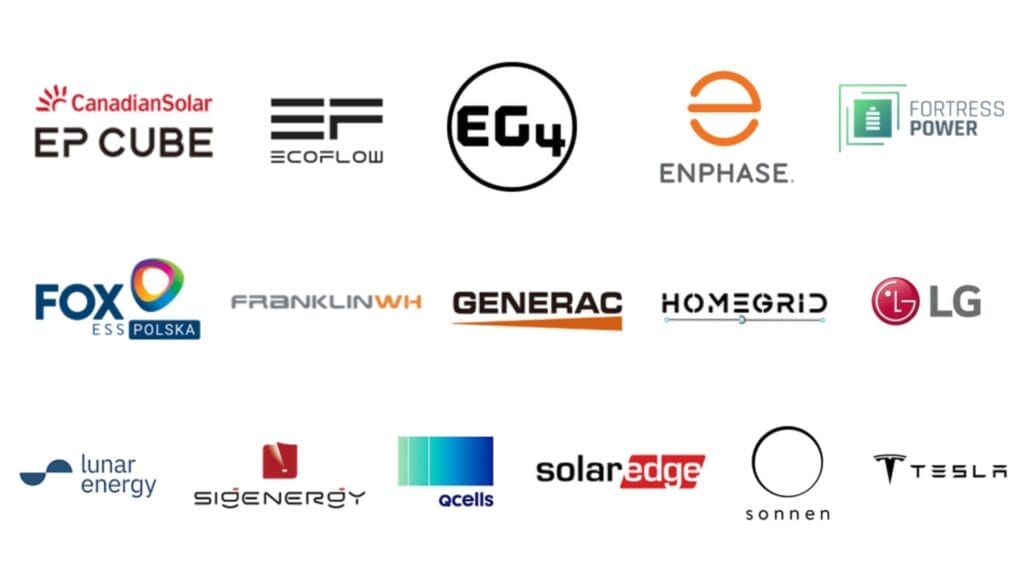
All of the brands that appear on our AVL have been thoroughly tested and vetted to ensure that the equipment they produce is of the highest quality. The manufacturers on our AVL include:
- Canadian Solar EP Cube
- EcoFlow
- EG4
- Enphase
- Fortress Power
- FoxESS
- FranklinWh
- Generac
- Lunar Energy
- Sigenergy
- Qcells
- SolarEdge
- Sonnen
- Tesla
Spotlighting Our Most Commonly Enrolled Batteries
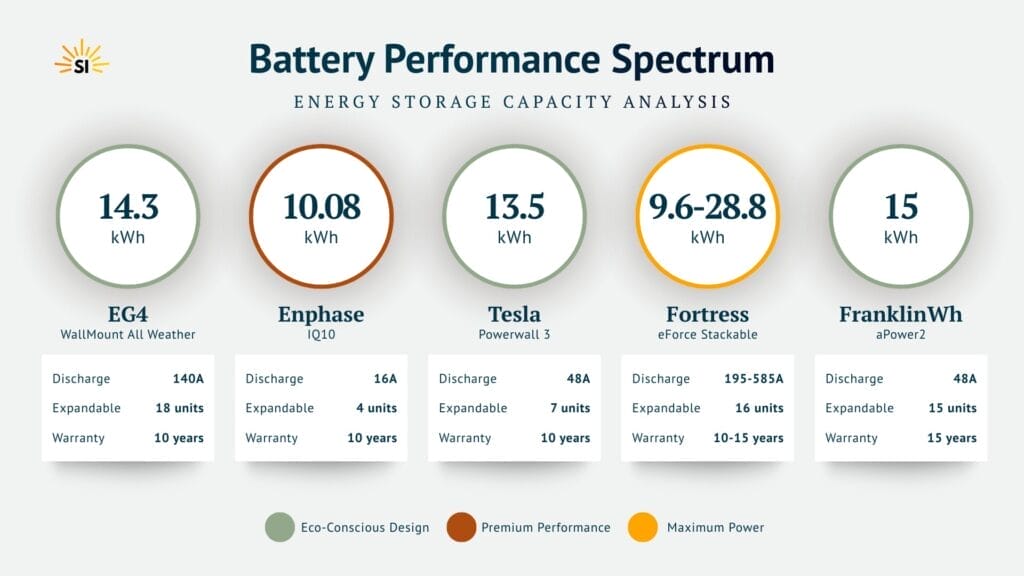
While all the brands on our AVL are top quality, our work with thousands of installs shows us that there are a few very popular options in the battery storage market. Below, we’ll highlight some of the standout batteries from our Best Batteries list that we find most commonly enrolled without warranties.
EG4 WallMount All Weather Battery
- Capacity: 14.3 kWh
- Discharge Rate: 140A continuous (200A max for 30 min)
- Expandability: 6 batteries per inverter; 18 batteries on-grid, 108 off-grid
- Warranty: 10 years, over 8,000 cycles
EG4’s WallMount All Weather battery is a standout in terms of power output potential. A single unit has 14.3 kWh of capacity and a continuous discharge of 140A. Using max discharge on a single battery would make the unit dry up extremely quickly, but the potential is there to run anything inside a home in a power-down scenario.
The expandability is another place where this unit shines. Grid-connected setups require the use of a microgrid interconnection device, called the GridBOSS, to have a singular 200A connection point to interface with a utility grid. Three inverters can be connected to a GridBOSS unit, with each inverter allowing for 6 batteries to be connected to it. Off-grid setups don’t require a GridBOSS and can have 16 inverters tied together.

Enphase IQ10
- Capacity: 10.08 kWh
- Discharge Rate: 16A continuous, 23A max(3.84 kVA & 5.7 kVA)
- Expandability: 1 per 20A branch circuit, 4 total with combiner
- Warranty: 10 years, 4000 cycles
Enphase’s IQ10 battery, and all of their products for that matter, are known for their high levels of reliability. The batteries contain Enphase microinverters, making them easy to service.
The continuous power output isn’t as high as some others on this list, making it a more common choice for those who don’t want a lot of backup power but want to best utilize their energy use throughout the day.
Because this is an AC-coupled battery, the expandability isn’t as straightforward. Each unit requires a double-pole 20A breaker. An Enphase setup would require the use of an IQ combiner, which comes with 80A of space, so 4 batteries could be connected to it. Enphase is known
Tesla Powerwall 3
- Capacity: 13.5 kWh
- Discharge Rate: 48A
- Expandability: 7 total units
- Warranty: 10 years
Tesla’s Powerwall 3 has exploded in popularity in recent years. As a hybrid inverter/battery, the unit has a battery and an inverter all in one convenient box. However, the inverter and battery can’t be serviced separately, so if one fails the whole unit must be replaced.
The Powerwall 3 boasts a powerful 48A max output for a single unit, and up to seven units can be attached in parallel. Four of those units are full Powerwalls, and Tesla also makes a Powerwall expansion unit, three of which can be connected to one of the Powerwall units.
Fortress Power eForce Stackable Whole Home Energy Storage System
- Capacity: 9.6 kWh – 28.8 kWh
- Discharge Rate: 195A – 585A
- Expandability: 16 units
- Warranty: 10-15 years
Fortress Power’s eForce Stackable Whole Home Energy Storage System features the highest discharge rate on our list at 195A for a single unit. Fortress’ system is unique in that it was built to stack together and easily expand as needed. Their largest units (28.8 kWh) can discharge up to 250A or 585A, easily backing up an entire home during an outage.
Fortress built its system around ease of installation, with units that easily stack and click together to maximize space. Batteries come with a standard 10 year warranty, but if installed with an Envy inverter and Guardian gateway, the system is eligible for a 15 year warranty.

FranklinWh aPower 2
- Capacity: 15 kWh
- Discharge Rate: 48A at 10 kW
- Expandability: 15 units per aGate
- Warranty: 15 years
FranklinWh’s aPower 2 is a great all-around battery. It’s got the highest usable capacity for a single battery unit on the list, and a respectable 48A max discharge, capable of backing up just about anything in a home. It also comes standard with a 15-year warranty, leading most other competitors in the category.
Franklin setups utilize their aGate, which is a microgrid interconnection device. The aGate allows up to 15 units to be connected to it, making for a massive possible system. Franklin’s battery also has a neat LED on the outside that shows charge status.
Learn more about Solar Insure’s AVL and how we evaluate quality standard
Learn more about Solar Insure warranties
Follow Solar Insure on our social media channels for all the information you could ever need about solar. Stay up to date with the latest in solar tips, trends, SI-30 product notes, and pro tips for success in your solar business.
