
New Jersey has been a steady mainstay in the solar marketplace for some time now. Its residential sector has grown steadily over the last ten years, and it is one of a handful of states offering a Solar Renewable Energy Credit incentive.
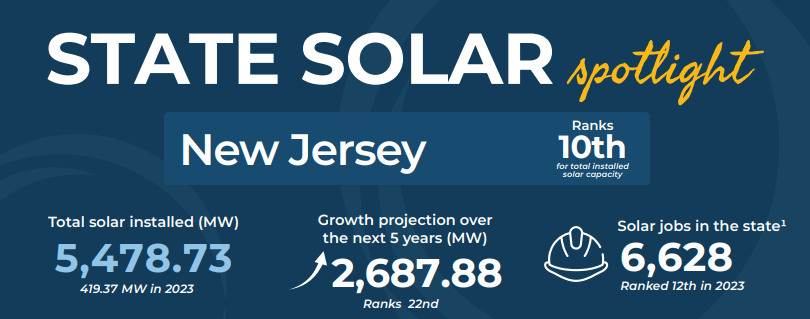
As of Q3 2024, New Jersey ranks 10th in the country in installed solar, up from 18th at the end of 2023. With a total installed capacity of 5,478 MW powering almost 8% of the state’s electric needs, New Jersey is quickly making a strong name for itself in the solar space.
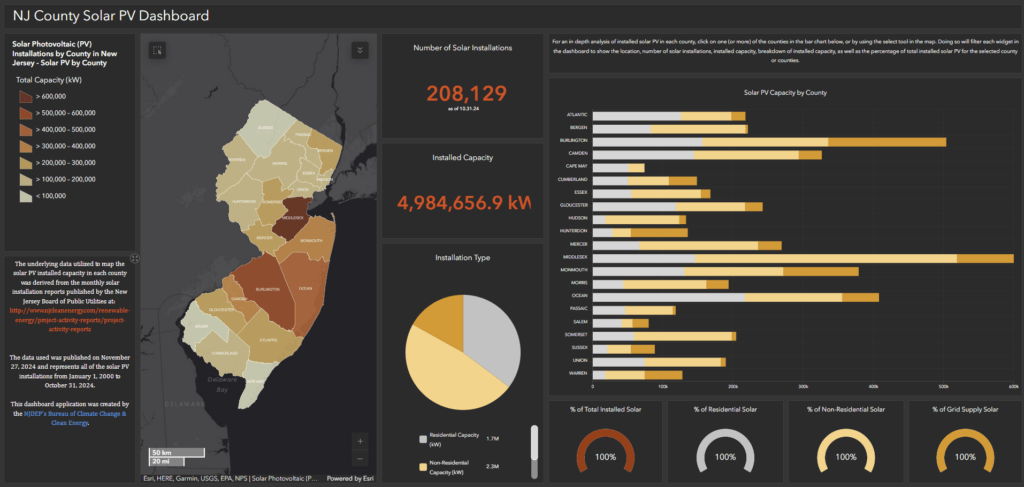
The New Jersey Department of Environmental Protection created a unique dashboard anyone can visit to see current stats on the New Jersey Solar Industry:
Below is a list of incentives available to solar owners in New Jersey. More information about New Jersey Solar Incentives can be obtained by talking with your solar provider.
Table of Contents
Federal Incentives
Federal Incentives
Federal Investment Tax Credit (ITC)
Commercial solar energy systems can take advantage of the Federal Investment Tax Credit 48E, which provides a tax credit of 30% of the total cost of the system, provided prevailing wage and apprenticeship requirements are met.
Residential systems can no longer claim any federal solar tax credit, as the One Big Beautiful Bill eliminated it for systems installed after January 1st, 2026.
Commercial Depreciation
Commercial asset owners can write off 100% of a project’s value in depreciation in the first year. The One Big Beautiful Bill reinstated the 100% bonus depreciation, while simultaneously eliminating the Modified Accelerated Cost Recovery System (MACRS) that previously depreciated solar energy systems over 5 years.
The depreciable basis of a project is reduced by half of the ITC value when combined with the 30% ITC. Here’s a quick example:
- Project cost = $800,000
- 30% credit = $240,000
- Reduced depreciation basis: $800,000 – ($240,000 / 2) = $680,000
A company’s tax rate is then taken into account to calculate the exact amount they’re able to write off. .
State Incentives & Programs
Sales Tax Exemption
The state offers a full exemption from state sales tax on all solar energy equipment, including active and passive solar technologies. The exemption also applies to batteries that store solar-generated energy. This program helps reduce upfront costs by removing the state’s 7% sales tax.
Property Tax Exemption
Solar arrays add value to homes and this property tax exemption allows that value to be omitted for property tax assessments. By applying for a certificate from the local assessor’s office, the home’s assessed value is reduced to what it would be without the qualifying renewable energy system.
Successor Solar Incentive Program (SuSI)
The SuSI program was created as the successor to New Jersey’s Solar Renewable Energy Credit (SREC) Program which ended in 2020. The previous program allowed homeowners to trade SRECs on an open market similar to stock trading.
SuSI has two sub-programs, the Administratively Determined Incentive Program (ADI) and the Competitive Solar Incentive Program. The competitive program is for commercial and utility-scale installations over 5 MW.
Under the ADI, a homeowner can receive recurring payments for SRECs produced by their solar panels over 15 years. One SREC is generated for every 1,000 kWh (1 MWh) of energy the solar panels produce. For program years 2024-2025, SRECs can be sold for $85 each. Payments are made monthly or quarterly rather than in lump sum.
Net Metering
All four of the large utilities in New Jersey credit excess generation from solar systems at full retail rates. As of August 2024, the average electric rate in New Jersey was $0.2067/kWh. This is a tremendous benefit to the consumer as they can fully utilize their energy regardless of their consumption. Unsurprisingly, states with retail rate net metering have relatively low battery storage usage rates.
A power true-up is done on an annual basis so excess generation can be used month to month. If a home has leftover excess generation at the end of that annual period, meaning its solar system produced more than 100% of its annual consumption, it is credited back to the owner at the wholesale rate.
Exact rates vary by utility and can change if a home is subject to time-of-use pricing. Check with your local utility for details specific to you.
- Atlantic City Electric (ACE)
- Jersey City Power & Light (JCP&L)
- Public Service Electric & Gas Co. (PSG&E)
- Rockland Electric
Solar in New Jersey
With full retail rate net metering and an SREC program, New Jersey solar homeowners have a top-tier incentive market. The state’s solar industry will only continue to grow, especially with the proposed upcoming Community Solar and Solar For All programs on the way. For more information specific to your situation and home consult your solar provider.

Elite Provider Spotlight: Sunlight Electri-Cal Solutions
We’re proud to spotlight Sunlight Electri-Cal Solutions, a Solar Insure Elite Provider based in Dublin, California, serving the greater San Francisco Bay Area across Alameda,...Continue reading→

Elite Provider Spotlight: Transform Solar
We’re proud to spotlight Transform Solar, a Solar Insure Elite Provider based in Tampa, Florida, serving the Greater Tampa Bay area, including Zephyrhills, Riverview, Land...Continue reading→

Elite Provider Spotlight: 360 Electric, Heating/Cooling
We’re proud to spotlight 360 Electric, Heating/Cooling, a Solar Insure Elite Provider based in Morton, Illinois, serving Central Illinois. Founded in 2014 as an electrical...Continue reading→
