The solar industry is full of complicated solar jargon, acronyms, and terms not used in everyday life that sound like a completely foreign language to anyone hearing them for the first time. Between sales language, installation and permitting specifics, incentives, and more, it can be hard to keep up with what your solar installer is saying.
This guide is designed to help you understand the complexities of solar. Here are some of the common words, phrases, and acronyms used in the solar industry:
Table of Contents
Sales Related Solar Jargon
Azimuth – Refers to the compass angle your solar panels face. 0° is north, 90° is east, 180° is south, and 270° is west. In the northern hemisphere, direct south is the most productive angle.
Roof Orientation – This refers to the direction that the roof faces, which affects the amount of sunlight received by the solar panels.
Site Assessment – This is an evaluation performed by solar professionals to determine the suitability of a location for solar panel installation.
Sun Path – The arc that the sun follows across the sky, which impacts the amount of sunlight a solar panel receives.
Shading – Obstacles such as trees, buildings, or other structures that block sunlight and reduce the efficiency of solar panels.
Panel Efficiency – The percentage of sunlight that is converted into electricity by the solar panels.
Solar Financing – Various options, such as loans or leasing, available to homeowners for financing the installation of solar panels.
Solar Loan – A financing option where the homeowner borrows money to finance the solar system, repaying the loan over time.
Solar Lease – A financing arrangement where the homeowner pays a fixed monthly fee to lease the solar system from a third-party owner.
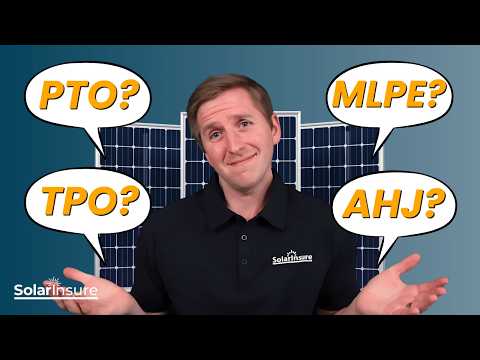
Third Party Ownership (TPO) – TPO systems are solar leases and PPAs where the homeowner or business owner does not actually own the equipment on their property. Instead, it is owned by a third-party organization, and the property owner pays a fixed or variable monthly amount for the energy produced by the panels.
Power Purchase Agreement (PPA) – This is an agreement in which a solar company owns and maintains solar panels on a homeowner’s roof and sells the electricity to the homeowner.
RFP (Request for Proposal) – A term used to describe a formal bidding process. Most often used for commercial solar arrays or projects on public buildings. An organization will send out an RFP, and multiple developers can submit their project proposals with pricing and terms.
DC to AC Ratio – A measure of the inverter capacity relative to the array’s DC capacity
Watt (W) – This is a unit of power, a basic building block of solar. It represents the rate at which electricity is generated or consumed. It’s commonly used to describe the power rating of a solar panel, i.e. 400 W. In this example, the solar panel is rated to produce 400 watts of power in perfect lab conditions.
Kilowatt (kW) – This is a unit of power. It represents the rate at which electricity is generated or consumed. Commonly used to define the size of a system, i.e., 8 kW. 1 kW is equal to 1000 watts (W)
Kilowatt-hour (kWh) – This is a unit of energy. It represents the total amount of electricity produced or consumed over time. Common uses include energy consumption (home used 500 kWh this month) or battery capacity (13.5 kWh).
Energy Audit – an assessment of a home’s energy use. The audit aims to identify opportunities for improved energy efficiency.
Solar Insolation – The amount of solar radiation received per unit area over a specific time period.
On-grid – Refers to a solar energy system that is connected to the electric grid. The majority of residential systems are on-grid, interfacing with a home and the existing electric grid.
Off-Grid – This refers to a standalone solar photovoltaic (PV) system that is not connected to the electrical grid. These systems are typically used in remote areas where grid access is limited and requires large battery banks.
Ground-Mount – This refers to a solar system that is installed on the ground rather than on a rooftop.
BIPV – Building Integrated Photovoltaics. These solar setups are built directly into a roof rather than sitting on top of them.
Solar Canopy – A structure that provides shade while also housing solar panels.
Solar Carport – A carport equipped with solar panels on the roof, providing shade for parked vehicles and generating electricity.
Solar Farm – a large-scale solar installation.
Solar Coaster – the cyclical nature of the solar industry due to policy changes or market shifts
Time-of-Use (TOU) Rates – A rate structure where the cost of electricity varies based on the time of day, encouraging homeowners to consume less energy during peak hours.
Rate Arbitrage – The process of storing energy in a battery when electric rates are lower and discharging when utility rates are higher. This saves more money as it reduces the amount of power a home would have to draw from the grid when prices are highest.
Demand Charge – A fee in utility bills that charges ratepayers based on the peak amount of energy they pull during a given month. Commonly seen on bills is a time-of-use (variable) pricing model.NABCEP – The North American Board of Certified Energy Practitioners. This is a certification that is widely considered to be the gold standard in solar.
Installation Related Solar Jargon

Balance of System (BoS) – These are all the components of a solar photovoltaic (PV) system, excluding the solar panels. This includes items like mounting structures, wiring, inverters, and monitoring systems.
Inverter – This is a device that converts the direct current (DC) electricity produced by solar panels into alternating current (AC) electricity. The AC electricity is then suitable for use in the home.
String Inverter – An inverter that converts DC electricity from a string (or series) of solar panels into AC electricity.
Microinverter – This is a small inverter installed on each solar panel. It allows each panel to convert sunlight into AC electricity, independent from the other panels.
Module-Level Power Electronics (MLPE) – These are devices, such as microinverters or power optimizers, that are installed at the individual solar panel level. Their purpose is to optimize performance and monitor output.
Maximum Power Point Tracking (MPPT) – Used to solar inverters and charge controllers to adjust voltage and current to maximize power output.
Single Line Diagram (SLD) – an electric drawing showing how a solar array is connected to inverters, batteries, and the home.
National Electric Code (NEC) – This is a governing code that dictates electrical safety guidelines and how connections must be made.
Authority Having Jurisdiction (AHJ) – Authority Having Jurisdiction. This refers to a local area building department from a city, town, or county that has authority over permits and inspections.
EPC – Engineering, Procurement, and Construction firm. This is a technical name for a solar installer who does all the engineering and permitting for a system, buys the equipment, and installs it. Non EPC firms exist and are given fully planned and permitted projects to simply install.
ESS – An Energy Storage System (also called a battery) is an optional component of a solar panel system that allows homeowners to store excess solar energy. The stored energy can then be used during periods of low sunlight or power outages.
Grid Connection – This is the process of connecting the solar photovoltaic (PV) system to the electrical grid. This connection allows homeowners to draw electricity from the grid when needed.
Interconnection Agreement – This is an agreement between a solar system owner and the utility company. The agreement outlines the terms and conditions under which the solar system is connected to the grid.
Permission to Operate (PTO) – It is the final step in the utility interconnection process to receive approval to activate your solar system and begin electricity generation.
String Combiner –A device that aggregates multiple strings of solar panels into a single output.
DC – Direct current. A form of electricity that is produced by solar panels. DC must be converted to AC to be used by a home or business.
AC – Alternating current. A form of electricity that is used in homes and businesses.
Photovoltaic (PV) System – This is a system that converts sunlight into electricity using solar panels.
Photovoltaic Cell (PV Cell) – This is the basic unit of a solar panel. It converts sunlight into electricity.
Power Optimizer – This is a device installed on each solar panel. It maximizes power generation by adjusting the panel’s output to current light conditions.
Maintenance Related Solar Jargon
O&M (Operation and Maintenance) – These are the ongoing tasks necessary to keep a solar system functioning optimally. This includes tasks like cleaning, inspections, and repairs.
Monitoring System – This is a system that allows homeowners to track and monitor the performance of their solar photovoltaic (PV) system. This includes monitoring energy production and consumption.
Hot Spot – A defect where part of a panel overheats, reducing its performance
PID (Potential Induced Degradation) – Panel efficiency loss due to voltage differences.
Bathtub Curve – a graphical representation of equipment failures over time. Failures are usually higher in the early part of an equipment’s life, lower throughout the middle years, and higher near the end of the equipment’s life.
Depth of Discharge (DoD) – The percentage of battery capacity used.
Round Trip Efficiency – Most common when talking about batteries, this is the efficiency of a system from the time energy is produced, charges a battery, and discharges into a home.
Performance Ratio (PR) – This is a measure of the actual output of a solar system compared to its potential output under ideal conditions.
Warranty – A guarantee provided by the manufacturer or installer that covers defects, performance, and the durability of the solar panels and related components.
Soiling – This refers to dust, dirt, or other substances that accumulate on the surface of solar panels and reduce their efficiency.
Incentives Related Solar Jargon
NEM – Net Energy Metering, also called Net Metering. This is a program where homes and businesses with solar can send excess power out to the electric grid and receive a credit for doing so.
ITC – Investment Tax Credit. This was an incentive from the federal government that gave homeowners who purchased solar a tax credit based onthe value of their system.
Feed-in Tariff (FiT) – This is a government program that provides financial incentives for homeowners to generate solar electricity and sell it back to the grid.
Performance-Based Incentive (PBI) – This is a financial incentive that provides payments based on the performance of a solar system over time.
Solar Incentives – Financial incentives, such as tax credits or rebates, provided by governments or utility companies to encourage the adoption of solar energy.
Solar Renewable Energy Certificate (SREC) – A tradable commodity earned by producing renewable energy, which can be sold to utilities to help them meet their renewable energy goals.
Follow Solar Insure on our social media channels to stay connected with the latest industry insights, trends, and expert perspectives. Discover valuable updates, helpful tips, and keep yourself informed and empowered in the evolving solar landscape.
Has your solar installer gone out of business? You don’t have to navigate the uncertainty alone. Discover how SolarDetect can help you with expert remote system checks, repair coordination, and monthly performance updates — backed by Solar Insure and the financial strength of Zurich North America. Take the next step toward peace of mind by exploring SolarDetect today.
