
Key Takeaways
Balcony solar, also known as plug-in photovoltaics (PIPV) or plug-in solar, is emerging as a low-cost, accessible way for renters and homeowners to generate clean energy, with growing legislative support across the U.S. and widespread adoption in Europe. These small systems typically produce 2,000–2,600 kWh annually, offering modest savings and payback periods around 7–8 years, though incentives are currently limited. While the technology is simple to install and expanding rapidly, considerations like inverter lifespan, mounting safety, and electrical capacity remain important for long-term performance and reliability
Solar Providers – ready to offer unmatched value for your clients? Click here to apply to become a Solar Insure Certified Provider.
Homeowners/Business Owners – Learn more about our warranty offerings here.
Balcony solar, more commonly known as Plug-in Photovoltaics (PIPV), has been in the news a lot lately, with several states passing legislation to allow its adoption. These micro-solar installations could allow renters, homeowners, and people who otherwise would not be able to adopt solar to benefit from low-cost solar energy.
To date, only Utah and Virginia have passed legislation to allow plug-in solar, but 28 states in total are considering PIPV bills in some fashion.
The technology is promising, but there are aspects to consider that are holding up some progress. Let’s explore those, how the technology works, and consider the long-term cost of ownership.
Table of Contents
New to the US, not the World
Balcony solar is a concept gaining a lot of steam in the US, but in Europe, PIPV technologies have existed and have been making an impact for quite some time. As many as 4 million households in Germany alone have installed balcony solar systems, and more countries across Europe allow for it. In Germany, balcony solar energy systems can even be ordered through IKEA

Most EU countries permit PIPV systems up to 2 kW, but limit export to the grid to 800W to protect the grid. The limitation isn’t too restrictive, given that most of these systems are installed in apartments and are on a smaller scale, but depending on energy use, it would make sense to also install a small battery to store excess energy.
Germany expects plug-in solar devices to cover around 2% of the country’s total electricity demand by 2045.
Where Does the US Stand?
As of the time of writing, Utah is the only state to officially have PlPV legislation fully passed. Virginia’s HB395 recently passed both houses and is now waiting on the governor to sign it into law, meaning systems would become legal to install on January 1st, 2027. In total, 28 states and Washington D.C., have balcony solar legislation in the works.

Both Utah’s and Virginia’s legislation limits balcony solar systems to 1.2 kW AC, so it’s likely that this could be used as a model for other states. One potential complication is the requirement of an interconnection agreement – a form reviewed and approved by the local area utility that often comes with additional fees.
Thankfully, both Utah and Virginia have included provisions to make PIPV exempt from needing utility interconnection agreements or homeowners needing to pay additional fees. If systems are allowed to export power to the grid, however, homeowners may need net metering agreements if allowed by the utility.
The legislation also includes requirements that the systems shut down when the electric grid is down, similar to traditional grid-connected solar. This “anti-islanding” is a common requirement to prevent damage to a home’s electrical system.
How Balcony Solar Works
The actual operation of balcony solar systems is pretty straightforward. Once you get your equipment, you either install it on a balcony railing, a freestanding structure, or even just in open yard space.
The panel connects to a microinverter or inverter/battery combo unit, then an extension cord is run from the panel setup to a standard 120V outlet. At a limitation of 1.2 kW AC, a 240V unit would require the outlet to be connected to a 10A or 15A breaker.
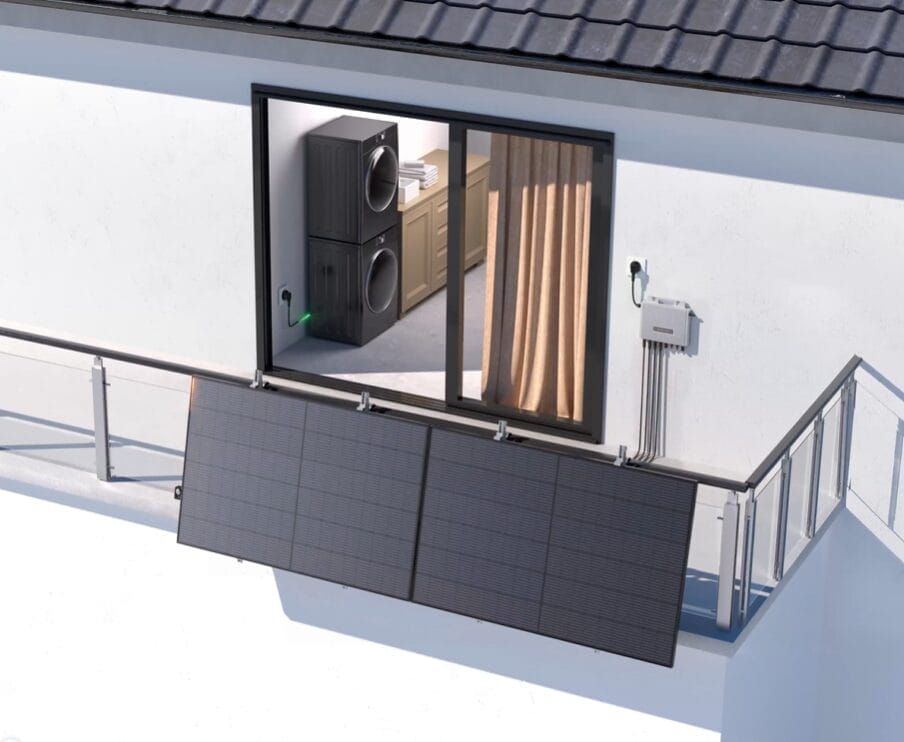
As the panel produces energy, that energy is converted to AC and fed into your home, powering active loads inside the house. Based on simulations we ran in NREL’s PV Watts calculator, depending on the weather, location, and panel angle, 1.2 kW AC of panels could produce anywhere from 2,000 – 2,600 kWh annually.
At an average electric rate of $0.14/kWh, a plug-in system could amount to yearly energy savings of $280 – $364. If you live in an area with higher electric rates or time-of-use pricing, the value could be significantly higher.
The ROI and Incentives
It’s great to be able to save money, but that doesn’t mean much if you never recoup the money you paid for the equipment. So what’s the ROI on a balcony solar system?
The team over at EcoFlow already has products available for this market. As you might expect, they’re only available for purchase in Utah right now. But their STREAM Ultra system has two options, an 800 W + microinverter system (two 400W panels) and a 1600W + microinverter system (four 400W panels). The 800W normally retails for $1,499, and the 1600W normally retails for $2,399.
The production example above assumed the four-panel system. So if you spend $2,399 on the system, install it yourself, and save an average of $320 per year, the system would pay for itself in 7.5 years. Areas with higher electric rates could see significantly faster paybacks.
As far as incentives go, because these systems are DIY and exempt from any formal utility interconnection agreement, it’s likely they wouldn’t qualify for most incentives available to traditional solar energy systems. As legislation in other states continues to advance, we could see plug-in solar included in some incentives.
Long-Term Cost of Ownership and Considerations
Clearly, plug-in solar has a major opportunity to provide low-cost, clean energy for millions of Americans at a time when energy prices continue to rise. But what about long-term costs, maintenance, and what else should homeowners know before investing in a PIPV system?
Solar panels are subject to power degradation as they age. Most panels account for this in their warranty, claiming between 0.25% – 0.5% per year, so it’s important to note that you will lose some energy over time.
The bigger concern is the inverter equipment. Through data on thousands of systems monitored by Solar Insure, our research found microinverters failed at a rate of roughly 5.5 out of every 10,000 units, which is relatively low. For units that did fail, our research found that, on average, they did so a year and a half after installation. In the case of the EcoFlow equipment, the inverter comes with a 10-year warranty, but on a 25+ year panel, owners should expect to have to buy a new inverter at least once during the full lifecycle.
The mounting hardware is another place to be cautious. A professional kit would likely come with the proper mounting brackets, but plug-in systems need to have strong mounting connections.
The last consideration is the outlet being plugged into. Because of the power being pushed back, homeowners need to ensure the associated breaker is large enough to handle the power, so an electrician may need to be involved.
A Major Opportunity for Solar
Overall, it’s encouraging to see positive movement on the balcony solar front. The rest of the world has been benefiting from this technology for a long time; it’s time the US allowed everyone the chance to reduce their energy bills.
Follow Solar Insure on our social media channels to stay connected with the latest industry insights, trends, and expert perspectives. Discover valuable updates, helpful tips, and keep yourself informed and empowered in the evolving solar landscape.
Has your solar installer gone out of business? You don’t have to navigate the uncertainty alone. Discover how SolarDetect can help you with expert remote system checks, repair coordination, and monthly performance updates — backed by Solar Insure and the financial strength of Zurich North America. Take the next step toward peace of mind by exploring SolarDetect today.
