
Key Takeaways
Prepaid solar financing, including prepaid leases and PPAs, is emerging as a popular way for homeowners to go solar after the loss of residential tax credits by leveraging commercial incentives through a temporary third-party ownership structure. Homeowners pay upfront at a reduced effective cost, while a lessor captures tax benefits and transfers ownership after several years, typically 5–6. While this model can reduce system costs by 15–30% and expand access to solar, it requires careful review of pricing, contracts, and long-term maintenance responsibilities, especially as tax incentives phase out by 2027.
Solar Providers – ready to offer unmatched value for your clients? Click here to apply to become a Solar Insure Certified Provider.
Homeowners/Business Owners – Learn more about our warranty offerings here.
In the wake of the residential ITC cancellation from the OBBB, installers have been looking for creative ways to help customers go solar without simply forcing them into third-party-ownership (TPO) agreements like leases and PPAs. One option our team has seen in the field gaining significant popularity is Prepaid TPO, AKA prepaid leases, and prepaid PPAs.
Already, the market is full of options that vary by state. Depending on where you are in the country, you’ll find names like Propel, HDM, Participate, and more. These new spins on an older form of financing offer homeowners a way to take advantage of tax credits that are now only available to commercial customers.
Let’s explore how this new financing works and how they are already altering the solar and storage space.
Table of Contents
How do Prepaid TPOs Work?
At their core, prepaid TPO solar options are essentially the same. A third-party entity (the lessor) owns the equipment on the roof for a short period.
In practice, this means the homeowner pays most of the system cost upfront, while the lessor temporarily holds ownership to capture available tax benefits. After a designated period, ownership can transfer to the homeowner.
Homeowners make an upfront payment for the entire purchase amount of the solar system, minus part or all of the tax credit amount. In most cases, ownership of the solar energy equipment can transfer over to the homeowner after a designated period of time – around 5-6 years.
Homeowners would either pay cash or finance the upfront payment. If they are financing, there may be additional costs, such as dealer fees or escalating payments, depending on the institution.
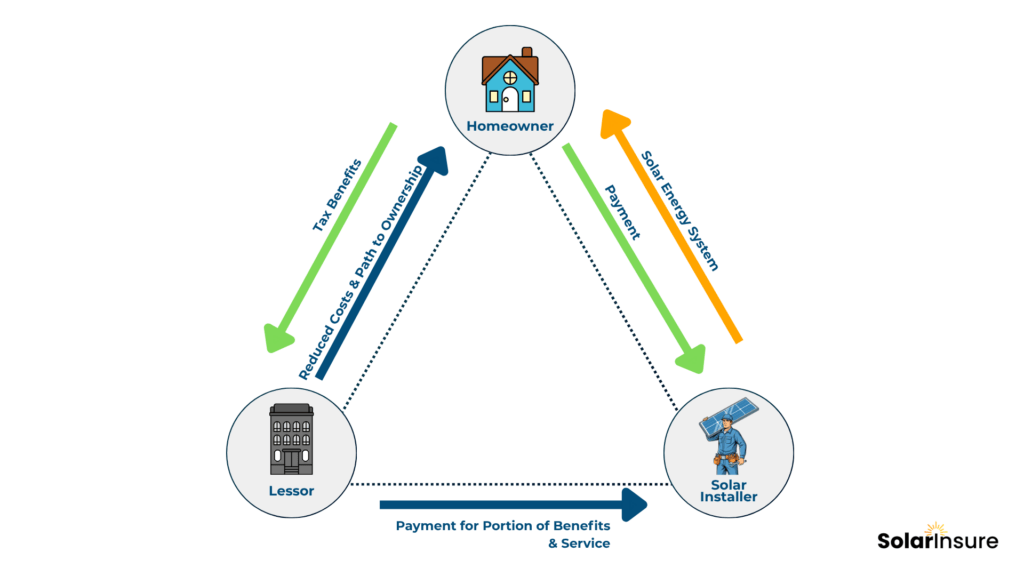
There are typically three parties involved in TPO options, whether prepaid or not. There’s:
- Homeowner
- Solar installer
- Lessor
The end user is the person whose house will have solar panels installed, the installer is the one who does the actual installation and maintenance, and the lessor is the entity that will own the system for the designated period of time. This structure allows the installer to complete the project, the homeowner to move forward with solar, and the lessor to capture tax benefits during the ownership period.
How do Prepaid Leases and Prepaid PPA’s Differ?
Prepaid options come in two flavors, prepaid leases and prepaid PPAs. The two differ in structure but accomplish the same goal. Leases have homeowners pay for the solar equipment itself, whereas PPAs have homeowners pay for the energy generated by the system.
Both approaches are designed to reduce effective system cost and, depending on the product, can provide a path to ownership after the initial ownership period.
From what we’ve seen in the prepaid market so far, both leases and PPAs can allow for transfers, but they differ in how ownership is transferred. Some products have an automatic $0 transfer; others require a nominal amount ($1) or a fair market value buyout to transfer.
Which option is available to a homeowner will largely depend on the company they’re working with and the area they live in. Some states don’t allow PPAs but do allow leases.
In some cases, PPAs will also include production guarantees because the agreement is tied to the amount of energy the panels will generate.
Why Are Companies Interested in Prepaid TPO?
The reinvention of prepaid TPO options stems from the availability of tax credits and from giving homeowners a valuable way to go solar. The One Big Beautiful Bill eliminated the 25D residential tax credit for homeowners who buy solar via cash or loan, but kept the 48E tax credit for businesses until 2028.
While traditional PPAs and leases are still an option, there is a significant market among homeowners who want to own the equipment on their homes, especially given that research has shown that owned solar systems increase home values by 5-10%. In contrast, TPO setups do not increase value and add challenges when selling.
Prepaid TPO offers homeowners a way to use credits to get lower-cost solar and a path to ownership. Solar installers have a tool to continue selling and installing projects, and lessors can take advantage of tax benefits.
Prepaid TPO Math
Before getting into the numbers, it helps to understand the basic mechanics. The homeowner contributes the upfront payment, the installer completes the project, and the lessor receives tax benefits tied to ownership. Those benefits can reduce the system’s effective cost.
All of the above sounds good in theory, but why not put some real numbers behind it.
Let’s say, for example, a solar installer sells a 10 kW system to a homeowner. At $3/W, that’s $30,000. If an install uses at least 50% domestic content for a project in 2026, they get to take a 40% tax credit from the federal government under 48E’s domestic content bonus. That is a $12,000 tax credit, leaving the net system investment at $18,000.
The lessor technically owns the systems and therefore captures the tax credit, and depending on the product, some or all of that value is reflected in a lower effective cost for the homeowner.
Not every prepaid will pass the full tax credit value to a homeowner, but let’s assume that is the case for this example. The homeowner either pays cash or finances that $18k and pays it to their installer. If they financed, the payment schedule is between them and their bank. By signing the agreement, the homeowner gives ownership to the lessor.
The solar installer receives the $18,000 payment from the homeowner and usually a payment from the lessor that represents a portion of the tax benefits.
On the lessor’s end, they receive the $12,000 48E tax credit and can also take advantage of depreciation tax credits. The Modified Accelerated Cost Recovery System (MACRS) allows businesses to depreciate solar assets over 5 years. Claiming the ITC reduces the depreciable basis of MACRS to 85% of the total system value, or 80% in the case of a 40% ITC.
Here’s the example calculation:
- System Cost: $30,000
- ITC (40%): $12,000
- Basis Reduction: $12,000 x 50% = $6,000
- Depreciable Basis for MACRS: $30,000 – $6,000 = $24,000
These additional depreciation benefits are part of what makes prepaid structures financially viable for lessors.
Of course, MACRS deductions are affected by tax rate, so a business doesn’t get a straight $24,000 credit. Shelf has a great tool to calculate the depreciable amount per year and estimated tax savings:
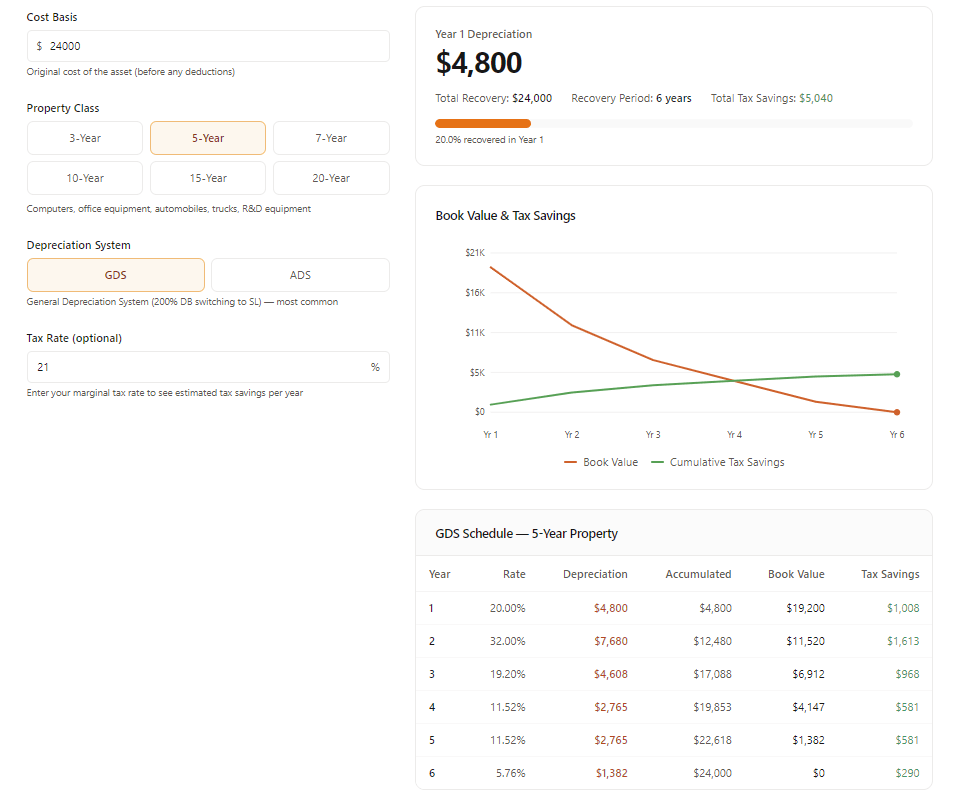
MACRS Depreciation Summary
────────────────────────────────────────
Cost Basis: $24,000
Property Class: 5-Year Property
System: GDS
Year 1 Depreciation: $4,800
Total Recovery: $24,000
Tax Rate: 21%
Total Tax Savings: $5,040
Year-by-Year Schedule:
| Year 1: 20.00% → | $4,800 depreciation → | $19,200 book value ($1,008 tax savings) |
| Year 2: 32.00% → | $7,680 depreciation → | $11,520 book value ($1,613 tax savings) |
| Year 3: 19.20% → | $4,608 depreciation → | $6,912 book value ($968 tax savings) |
| Year 4: 11.52% → | $2,765 depreciation → | $4,147 book value ($581 tax savings) |
| Year 5: 11.52% → | $2,765 depreciation → | $1,382 book value ($581 tax savings) |
| Year 6: 5.76% → | $1,382 depreciation → | $0 book value ($290 tax savings) |
Generated at shelf.nu/tools/macrs-depreciation-calculator
So, in this example, the lessor could receive tax benefits totaling $17,040. A quick disclaimer – Solar Insure nor I are tax law experts, and exact amounts may vary or be available on a case-by-case basis. The above does not represent all cases. Always consult a certified tax professional.
During the period the lessor owns the system, they are typically responsible for its maintenance. Once a homeowner can transfer ownership to themselves, any maintenance liability falls to the homeowner, along with the associated manufacturer’s warranties.
What Do All Parties Get Out of Prepaid
All the numbers and calculations can get quite confusing with prepaids, so let’s simplify it down to the interested parties and what they get out of selling a prepaid.
Homeowners
- Get to go solar, save on energy bills, and take advantage of tax credits. Save between 15% and 30% on the cost of solar and can eventually own the equipment on their home.
Solar Installers
- Can offer their customers exceptional value on a solar purchase
- Get paid by the customer and a portion of the tax benefits from the Lessor
Lessor
- Receive tax benefits associated with the system
- Transfer liability away from themselves
Things to Watch Out For
So in theory, prepaids can be a situation where everyone wins. Homeowners get to go solar for a discount, installers can give great value to homeowners and continue generating business, and lessors get tax benefits. But there are some considerations.
Homeowners
For homeowners, it’s important to read and make sure you understand the contract but these are complicated. A big area to watch out for is the price. Because discounts are being passed along, the concern is that the initial price could be inflated. Best practice is to get quotes for prepaids and a straight cash or finance purchase.
O&M is also a consideration to make. While the lessor owns the equipment, they’re in charge of maintaining the system. But once it transfers ownership, maintenance falls on the homeowner. You do have manufacturer warranties, but you would still likely need to pay for labor costs to replace equipment that breaks. Remember, solar is a 25+ year investment.
Solar Installers
The biggest concern for a solar installer is putting too many eggs in a basket that is based on a tax credit, which is ultimately going to go away. The OBBB ends the 48E tax credit at the end of 2027. In the past, some TPO providers have had cash flow issues that have negatively affected installers, so we’d recommend a healthy mix of options in your sales belt.
Solar Insure and Prepaid TPO
Solar Insure believes that direct ownership of assets is in the best interest of homeowners and the health of solar providers.
Since prepaid TPO offers pathways to direct homeowner ownership, Solar Insure is vetting prepaid financial products for use with our SI-30 warranty products. As ownership eventually transfers to the homeowner, long-term system performance and protection become important considerations.
If you are a Solar Insure Certified Provider, please reach out to your Sr. Account Manager to learn more.
The Impact on the Industry
So what impact will prepaid TPO have on the industry? In the short term, they can be a great financial tool for homeowners to take advantage of available credits and get low-cost solar that they can one day own.
But the reality is that the 48E tax credit is only available until December 31st, 2027. Unless that is extended, neither TPO nor direct ownership will have available credits, making the value gap between them small.
Prepaid TPO is a nice stopgap during this transition period, but ownership via cash or a loan will eventually win out as a long-term solution.
Follow Solar Insure on our social media channels to stay connected with the latest industry insights, trends, and expert perspectives. Discover valuable updates, helpful tips, and keep yourself informed and empowered in the evolving solar landscape.
Has your solar installer gone out of business? You don’t have to navigate the uncertainty alone. Discover how SolarDetect can help you with expert remote system checks, repair coordination, and monthly performance updates — backed by Solar Insure and the financial strength of Zurich North America. Take the next step toward peace of mind by exploring SolarDetect today.
