
Key Takeaways
Jinko Solar has introduced new anti-dust solar panels built on its high-efficiency Tiger NEO 3 platform (650–670W) that use a nano-coating to reduce soiling losses, one of the biggest factors impacting solar production. The coating combines anti-static properties, hydrophilic self-cleaning surfaces, and photocatalytic reactions to prevent dust buildup and break down organic contaminants. Lab testing suggests the panels can produce 4–6% more energy than conventional modules, potentially lowering maintenance costs and improving long-term performance, especially in dusty environments.
Solar Providers – ready to offer unmatched value for your clients? Click here to apply to become a Solar Insure Certified Provider.
Homeowners/Business Owners – Learn more about our warranty offerings here.
Solar panel manufacturers are constantly innovating and redesigning panels to achieve the highest production possible. The first step was focusing on efficiency; in 1985, the University of New South Wales achieved 20% efficiency in lab settings, but commercially available panels over 20% wouldn’t become available until the 2010s. Now, most panels fall between 20% and 25%.
In recent years, manufacturers have turned to bifacial panels and physically larger panels to produce extra energy. But larger sizes pose installation challenges.
Rather than just changing how many cells a panel has, Jinko has introduced an innovation: anti-dust panels designed to reduce the effects of soiling.
Let’s explore the new technology they’ve introduced and the effect it could have.
Table of Contents
Panel Specs
Jinko is changing the coating on the front glass of its panels to a new formulation that more efficiently reduces the effects of soiling. The new panels will be built on their Tiger NEO 3 line, which is a super high-efficiency, bifacial panel ranging from 650W to 670W.
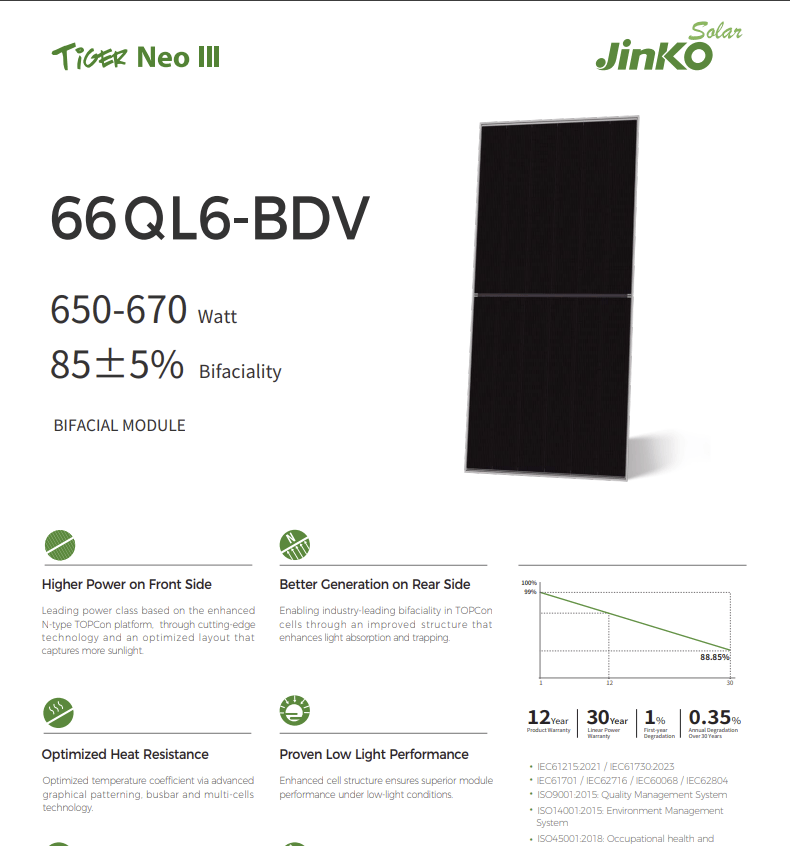
| Maximum Power – Pmax [Wp]* | 650 | 655 | 660 | 665 | 670 |
| Maximum Power Voltage – Vmp [V] | 42.57 | 42.70 | 42.78 | 42.85 | 42.92 |
| Maximum Power Current – Imp [A] | 15.27 | 15.34 | 15.43 | 15.52 | 15.61 |
| Open-circuit Voltage – Voc [V] | 50.26 | 50.44 | 50.50 | 50.55 | 50.60 |
| Short-circuit Current – Isc [A] | 15.98 | 16.04 | 16.14 | 16.24 | 16.34 |
| Module Efficiency STC [%] | 24.06 | 24.25 | 24.43 | 24.62 | 24.80 |
| Bifacial Factor | 85 ± 5% | ||||
| Dimensions | 2382×1134×30 mm (93.78 × 44.65 × 1.18 inches.) | ||||
| Warranty | 12-year product, 30-year linear power, 0.35% annual degradation | ||||
While the panels themselves are pretty remarkable and on the upper end for commercially available panels, the new anti-dust coating solves a key challenge all panels face: soiling losses.
The Anti-Dust Coating
Soiling losses are present on any panel in service, but especially in dry, arid regions, where dust and buildup can lead to serious power losses. According to the International Energy Agency, soiling is one of the most influential factors impacting solar production, estimated to cause a production loss of 3-5% annually.
Jinko’s panel mitigates losses by employing a new coating on the panel glass to both stop particles from sticking and aid in clean-up. From their announcement, the new coating gives the panels:
- Anti-static & Anti-adhesion: the nano-coating suppresses static electricity, which reduces the ability of fine particles to stick to the panels.
- Superhydrophilic self-cleaning: The coating becomes hydrophilic when exposed to water, meaning rainwater can more effectively remove contaminants that end up on the panel.
- Photocatalytic smart decomposition for organic contamination: when the coating is struck by light, a complicated chemical reaction occurs that releases molecules which break up organic matter like bird droppings.
- High Durability and Long Lifespan: The nanocomposite materials are tempered to ensure high durability against all types of weather.
- Intelligent frame design: the short side frame of the panel is parallel to the glass, allowing contaminants to more easily slide off.
Based on lab testing, Jinko has found that these new panels achieve 4%-6% more power than conventional modules exposed to the same conditions. Operating in high-dust environments can yield even greater results. As we said earlier, rather than simply making bigger panels, Jinko is mitigating common issues that reduce performance.
Hydrophilic vs Hydrophobic
The scientific highlight of these panels is points two and three above. The new coating on these panels makes water behave hydrophilicly, inducing a self-cleaning effect. What does that mean?
To understand how this works, you need to know the difference between hydrophobic and hydrophilic. Hydrophobic is something that doesn’t mix with water. A great example of this is putting Rain-X on your car; water beads up rather than flattening out because the surface of the car is now hydrophobic. Through natural motion and angles, the water runs off once the beads get big enough.
But on low angles, the water resists movement and takes longer to evaporate, leaving stains or streaks that affect production. Hydrophilic substances are “water-loving”, meaning they interact with the water and allowit to spread out into sheets and slide off more quickly.
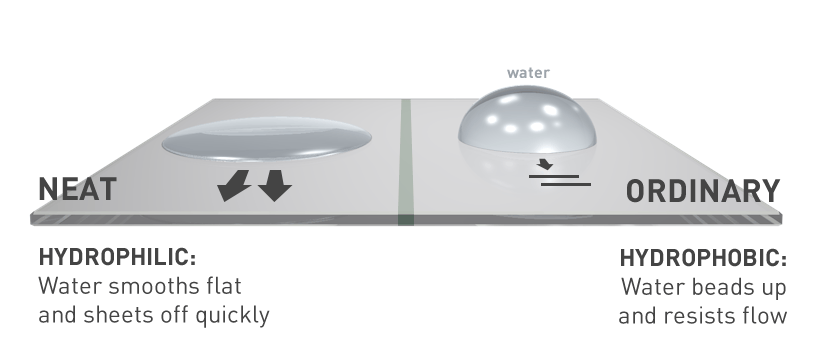
Since water is less resistant to movement and spreads out, it can more easily wash away contaminants that find their way onto the surface.
The Photocatalytic Reaction
The other innovation included in this coating is that it allows for photocatalytic decomposition. Photocatalysis is a reaction where electron-hole pairs are created when a semiconductor is exposed to light.

The above video uses an example of Titanium Dioxide, although Jinko doesn’t say what their coating is. When titanium dioxide is exposed to sunlight, it releases an electron that pairs with water in the air to produce superoxide anion. The now positively charged surface takes electrons from water in the air and produces Hydroxy radicals.
Hydroxy radicals and Superoxide anions react with organic material to decompose it. This reaction, combined with the hydrophilic water, can effectively remove contaminant buildup from panels.
Jinko on the Solar Insure AVL
At Solar Insure, we strive to make solar a secure investment for homes and businesses that make the switch to clean energy. Our Approved Vendor List (AVL) manufacturers are rigorously vetted, and only equipment from the AVL can be covered by a Solar Insure warranty.
Jinko’s solar panels are included on our AVL. Homeowners looking to get Jinko panels for their energy ecosystem can also have the 30-year material and labor production provided by our warranties.
Impact on The Industry
This innovation from Jinko represents a potential new standard in panel manufacturing. By adding this new coating, Jinko is making a more efficient and productive panel usable in all scenarios. Side by side with an equal-wattage panel, the Jinko panel now has a competitive edge in that the long-term cleaning costs are drastically reduced.
Jinko said in their announcement that orders will open up in May 2026, and mass production is expected to begin in June.
Follow Solar Insure on our social media channels to stay connected with the latest industry insights, trends, and expert perspectives. Discover valuable updates, helpful tips, and keep yourself informed and empowered in the evolving solar landscape.
Has your solar installer gone out of business? You don’t have to navigate the uncertainty alone. Discover how SolarDetect can help you with expert remote system checks, repair coordination, and monthly performance updates — backed by Solar Insure and the financial strength of Zurich North America. Take the next step toward peace of mind by exploring SolarDetect today.
